Michel Laub
A Walk With the Giant
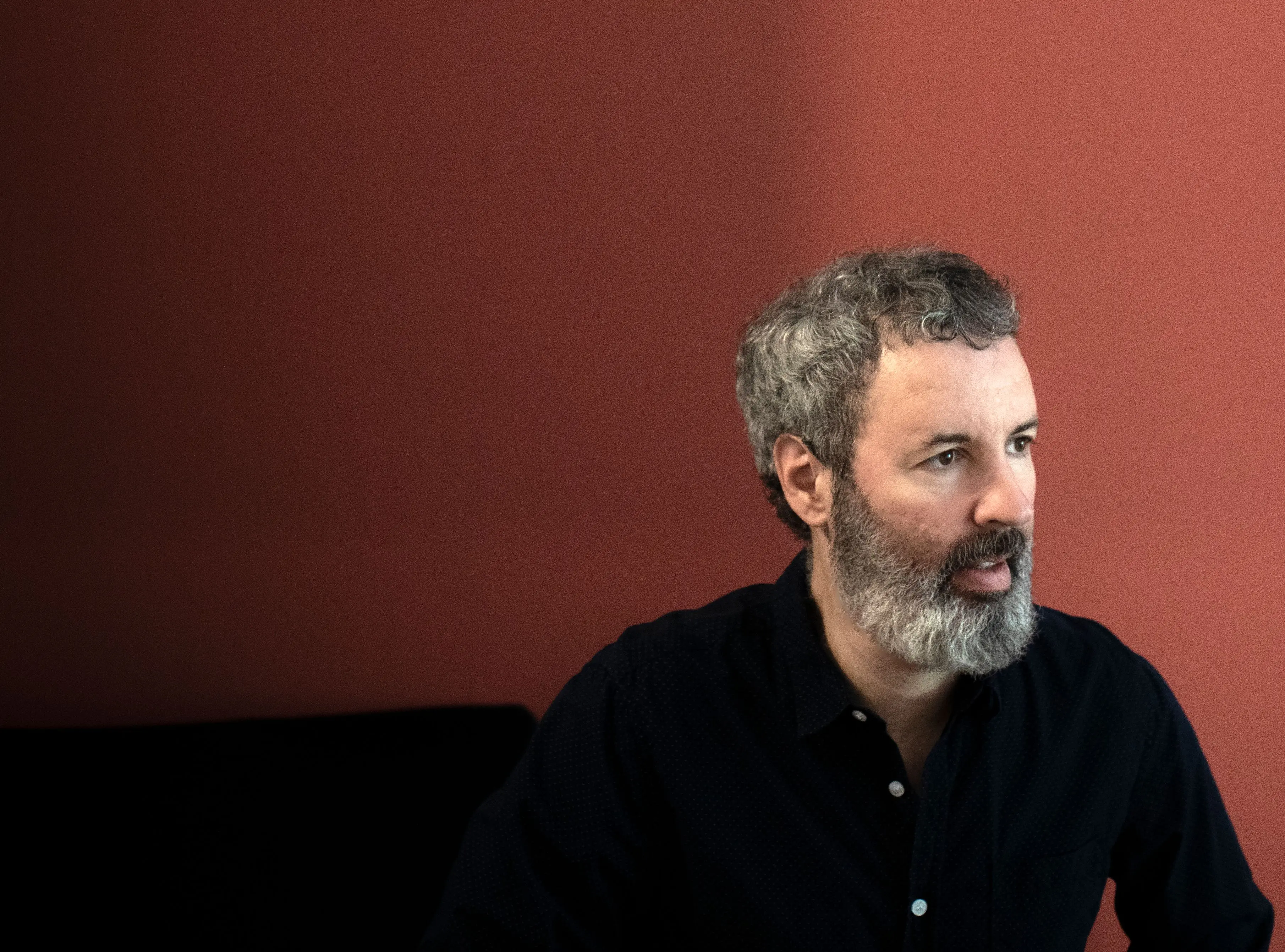
From the author of the critically acclaimed 'Diary of the Fall' (2011) and one of the leading names in contemporary Brazilian literature, the just-published 'A Walk With the Giant' is a novel about facing the past, reflecting on memory and forgiveness in a divided society, and the way Jews deal with political extremism in Brazil.
The book opens with Davi Rieseman, a Jewish lawyer and activist, standing on a stage facing an audience of other Jews. In a speech that combines cynicism and generosity, he tells the story of his relationship with his father-in-law, mother, wife, and daughter through the lens of very specific reflections on issues in the news.
1.
The future of an idea.
“My dear colleagues, partners and friends.”
For example: you wearing a tie.
“I’m going to begin by talking about a name.”
You standing on the stage. A lectern, a microphone in front of you.
“More than just a name, actually. Do any of you know who Old Uri’s great hero was?”
A white spotlight on you. The hall is full. Your speech about Old Uri, and Germany, and New York a hundred years ago.
2.
In New York a hundred years ago there was a boxer called Benny Leonard. There were other boxers around too, none of whom looked like the Gumex-haired guy on the poster. The things a man represents when he steps into the ring: you always liked talking about Benny Leonard’s hair, about the shorts he was wearing the day he won the lightweight title. A champion like him in the United States of America – the twenties – back then, in Harvard… Yes, you used this kind of trick in your speeches: holding the audience’s attention with some long-forgotten detail.
“My dear colleagues, partners and friends.”
A crippled race.
“I’m going to begin by talking about a hero.”
A race with defective bodies, those were the words they used at Harvard.
“A hero can come into our lives in all sorts of ways, and for Old Uri…”
You enjoyed starting off like that. Audiences liked it when you did. So there was no reason for it to be any different that night: everything in the hall was so familiar, the family names, the physical characteristics of those attending. You are absolutely right in that respect: history repeats itself like the mechanism of a trauma.
3.
“My dear colleagues, partners and friends. Thank you for being here. Some of you know me already, others are hearing me speak for the first time. Some of you are my age, others I can see are young – glad to meet you, I’m Davi Rieseman. Tonight is every bit as important to me as being a part of this family, of this project.”
Yes, the mechanism of a trauma.
“To be accepted by this family is an honor I will carry with me always. Which is why I wanted to begin with some words about my father-in-law. My father-in-law’s hero was a boxer from New York, Benny Leonard, many of you know this already, but no harm in repeating it because when you travel business class…”
That’s what a psychiatrist would say.
“Anyone who travels to New York today, those of you who stay in five-star hotels, just imagine the city as it was. Each of the city’s neighborhoods, the Lower East Side itself, history can be a big idea that comes and goes like… Psychiatrists like talking about that. A psychiatrist will draw a connection between that and a trauma. A plot that keeps on returning to the same place, to the same date.
“Old Uri liked dates. I had my father-in-law in my life for many years, how often must I have heard him say as much himself, so when I talk about trauma I’d like you to imagine the same point in the plot. January thirtieth of nineteen thirty-three. A lot of people think that’s where it starts, and you probably think so too, and so would I if I hadn’t gotten to know Old Uri so close-up.”
4.
“Old Uri spent his whole life saying that Hitler’s swearing-in as chancellor was not the beginning of anything. It might have been for Germany or the rest of the world, but not for us. In nineteen thirty-three, Europe was starting to distract itself in diplomacy, counting the soldiers and tanks on each side, while in reality, well, you all know.”
A glass of water atop the lectern.
“Of course, you did all this at school. I studied with some of you, in the same cohort.”
Picking up the glass. Taking a sip.
“Books tell us about the ideas of the time, but always from the German perspective. So many pages about nationalism and imperialism, about Prussia and the operas of Wagner; now, switch the point of view, to what was really going down in Berlin or Munich in the thirties. It’s one thing for a healthy citizen from there, something quite different for somebody who was not seen as healthy.”
How many sips from how many glasses, from the night of your speech until today?
“On the day the Nazis came to power, there were already thousands of people like that. That’s what mattered to Old Uri. At school we learn that the extermination camps were born out of euthanasia clinics. And euthanasia clinics were born out of an idea. It’s really just a question of looking at how everything started, at what’s in the party pamphlets, at what later became enshrined in law.”
5.
“At school we get taught that Nazi law started out by defining disabilities. Then it transformed disabled people into sick people, and it locked the sick people away in clinics far from the big city centers. Because it’s one thing to see a poster up on the street, a warning about the dangers of some virus or bacteria, ailments afflicting the body that’s drawn there on the poster. It’s one thing never actually being faced with one of those bodies yourself, just being a German who goes to the bakery, and takes the tram, and likes to sit in the square feeding the pigeons.
“It’s one thing to put the clinics out of sight, then the extermination camps further away still, at the end of a railway line or some village in Croatia, or in Krakow, but do things really just get there by accident? Why is it so easy to transform everything into an abstract logic of science, of health, something you might find in a book by Darwin or Pasteur – only Evolution, which never looks back?”
6.
“That’s the question my father-in-law was asking. It’s a long road to naming a bacteria ‘bacteria’, an extinct species ‘extinct species’. So Hitler comes to power in thirty-three, and he has almost a decade ahead of him to work on things. The decade builds on what came before – just look at the whole of the twenties, café culture in the Weimar Republic, shopping carts full of worthless banknotes.
“Look at Darwin and Pasteur in Berlin and Munich – while on the other side of the ocean… As if Germany and the United States in the twenties were two laboratories. And just so as you can make the comparison, the president of Harvard was saying at the time that Jews were an inferior race, in physical terms. A crippled race, that’s the expression he used. Sick people in clinics and in universities. People who needed to be kept out of classrooms and off sports pitches.
“People being kept out of sight, that’s the first step. But here’s the thing, look what each place did with those beginnings. Take an American Jew in the twenties – not much difference between living there or in some European ghetto. A quarter of prisoners in New York were Jewish men. Half of all prostitutes were Jewish women. So – a family on the Lower East Side back then, what do they talk about over dinner? A bowl of thin soup, you really think they’re going to be discussing universities for their children? Any future lawyers or doctors at those dinnertimes, or Harvard applicants? What happens when these children are walking round their dark neighbourhood, crossing from one block to the next not knowing what they’re going to find? Every Lower East Side alleyway. Every story about a pogrom or mass exodus, the horrors of a two-thousand-year diaspora, and when you imagine what might happen again in the twentieth century, how are we supposed to deal with that?”
7.
Yes, Davi, how do we deal with it? A good theme for opening a speech: the plot that repeats itself – that’s the future of ideas. But actually living in that future, there’s the problem: because you do recognise where we are, don’t you? Look around, unfortunately we’ve had to bring you here.
8.
Unfortunately, you are going to have to remember: the reception area of a hospital. At the far end of the room there are the turnstiles, the elevators. You will step into an elevator with us and visit some rooms, some wings of the hospital, and you’ll have to answer our questions while you do. Those answers will be compared with what you said on the night of the speech: your words so many years ago, the leader standing before his friends in the audience.
9.
“Have you ever heard of muscular Judaism? It’s an idea from the nineteenth century, which was born in Europe and reached the United States in the nineteen-twenties. It came from Max Nordau, a journalist and doctor, and at first the whole thing seemed no more than a medical notion. Max Nordau talked about a sickness from the ghetto, a Judaic angst from the ghetto that is the inheritance of that two-thousand-year night. Anyone who lives based on angst like that is scared to cross the street, to tie his shoelaces, and that’ll determine how you walk, how you talk, how you breathe.
“Muscular Judaism says that sickness is a manifestation of angst in the body, just as it is that of the body in angst. One thing feeds the other, just as general history is individual history and vice versa. Changing one requires changing the other, and which of the two changes is more viable? That’s more or less how the argument goes: you can depict us as bacteria on a poster, you can rob us of our chance to play a role in society, you can say or do whatever you like in Europe or in Harvard, but just try showing up on the Lower East Side. At some point you’re going to have to look at us head-on. To see us, in the neighborhood school, or on a dark street, or in a boxing ring.”
10.
“Boxing only became a black man’s sport from the middle of the twentieth century. Before that, down on the Lower East Side in Benny Leonard’s day, my friends, the champions had names like Joe Choynski and Kid Kaplan. They had nicknames like The Little Hebrew, The Bull of Zion. Now that’s what I call visibility, it’s all happening on one block someplace but if we take that model and expand it, imagine what would happen in the country or the world if every street was like that. Thousands of streets like the ones on the Lower East Side, that’s what Old Uri was saying.
“Old Uri had a poster with a photo of Benny Leonard on it. When the old guy was a teenager, the poster was next to his bed. He used to look at the poster, Benny Leonard with Gumex in his hair for boxing matches, he had a six-pointed star on his shorts, and I mention this because that’s the age when we start to understand the world. How can we make our mark on the world, who am I going to knock out?
“Now, I know what some of you are thinking. Old Uri was born here in Brazil, maybe he shouldn’t even be worrying about things like that, or obsessing over them, a whole life spent wondering what would happen if there were more examples like the boxer Benny Leonard. If every family in twenties Europe had been talking about it the way Jewish families in America were, how many people inspired by muscular Judaism could have… Imagine thousands of people like that in the Weimar Republic. And even with what came later, with the Nazi victory. In the thirties, up until the clinics and the extermination camps, an army of Benny Leonards ready to confront any German who mentioned Darwin and Pasteur while out feeding the pigeons in the square – could there have been so much alienation then? Collaboration? Or support for the massacre? None of this would have changed the fate of the Jews in the war, sure, no one’s stupid enough to believe that, but can we be certain there would have been six million deaths? That’s what Old Uri was asking, what if there were less? I’m not even saying millions less, maybe thousands. Maybe hundreds. The number isn’t important; he was talking about a principle, how many Jews wouldn’t have also died because of, well, an image problem?”
11.
“I know what you’re all thinking. I’ve thought it myself often, because the old guy used to talk and I’d just sit there quietly, partly out of good manners, I was in his home after all, partly because I was just digesting everything, well, that’s actually totally logical, ’cause when you hear someone talking like that… At the same time, think about my father-in-law’s consistency. He knew people didn’t like him, I mean, there were always people kissing up to him, after all he was the guy who founded Benny Insurance, and he chose the name of the firm in tribute to Benny Leonard, but who really wants to spend hours listening to that kind of talk? You think Old Uri didn’t know ideas like that bother people? Wasn’t his fight all the more consistent because of it, because that’s what muscular Judaism feeds on? It’s a way of us saying, to hell with gentleness. To hell with the gentle or paternalistic image people might have of us.”
12.
“Muscular Judaism could have died out in the twenties, but you only need to look at the rest of the century. The first image of the Jews after forty-five is the one disseminated by the Allies, all those victims in that footage and those photos of extermination camps, alive or dead, either way. This is the image that history books say could have moved ordinary people during the war, if the camps hadn’t been so distant from people’s daily lives, but would that alone have been enough?
“Think about how an image reaches a person. If I present pictures of the extermination camps now, everyone will react differently, especially as everybody here has already seen them so many times. It’s eight in the evening now, and there’s no guarantee that you, who are yourselves Jewish and lost relatives in the war, or something similar, relatives who escaped and started again without money and not speaking the language in a strange country, in short, you who are in the situation of every Jew in the second half of the twentieth century and who know what those images mean, even so, my friends, there’s no guarantee that anybody here might not be thinking, I’m tired, I’m hungry, the last thing I want is to listen to this Davi Rieseman guy keep going on about other people’s feelings.
“We know all this. And we know the response could be even worse, too. That someone who is not Jewish might look at those images and, well, I don’t want to keep on repeating Old Uri’s words. Old Uri wasn’t exactly a pleasant person to be around. I spent two decades listening to my father-in-law hijacking conversations by returning endlessly to this topic, so for now I’ll just say that being disagreeable was his way of getting people’s attention. Getting a specific reaction from whoever was listening. The old man used to say, doesn’t anyone realise how one thing’s linked with another? That the fact that these images were created by the Nazis, or out of something that the Nazis did, gives them a Nazi perspective? And that that was just what the Nazis wanted, for the world to look at those images of the Jews in the same way they saw the Jews themselves?”
13.
“Could it be that Jews just don’t see the trap? Why do people think this has to be a rule, that a person will look at a victim and feel pity? Sometimes, the old man used to say, it’s the opposite. The person looks and they feel rage, contempt, because the victim is trying to take something from us by playing the victim.
“The old man used to say, that was how the Nazis sowed the seed of that image. Even if they lost the war, they knew they could keep that one victory, you only have to look at today’s world to see how the prediction makes sense. Imagine what it’s like for an American guy or a European today. A guy from the Middle East. Take the varnish off these people, till all you’re left with is what they feel under the label, what they really want to say when they see those photos so many years later, so many decades, almost a century past and you really think there’s no possibility of somebody there saying, but what has that skeleton-like body got to do with me?
“What harm did I ever do to that skeleton? Why do I have to keep apologising for being a German who’s twenty-one, or an American who’s lost his job and lives with five kids in a trailer? A Bosnian war veteran. An Arab, what do you expect that guy to say a hundred years on? This man with no land of his own, who’s fighting over land and water with the other lot and on top of that he’s still got to feel sorry because somebody’s grandfather or great-grandfather was a skeleton chucked into a pit? Those were the old man’s questions, he’d go on repeating them incessantly, it was breakfast, lunch and dinner, what’s the point of still going on showing people the picture of that skeleton today? It had an effect in the past, it didn’t last long, exactly the period between the dissemination of the images and the creation of the state of Israel, because the next minute Israel got attacked, it’s seventy years of attacks from all sides, and everybody here knows it and you’re still going to expect the planet to cry over that?”